
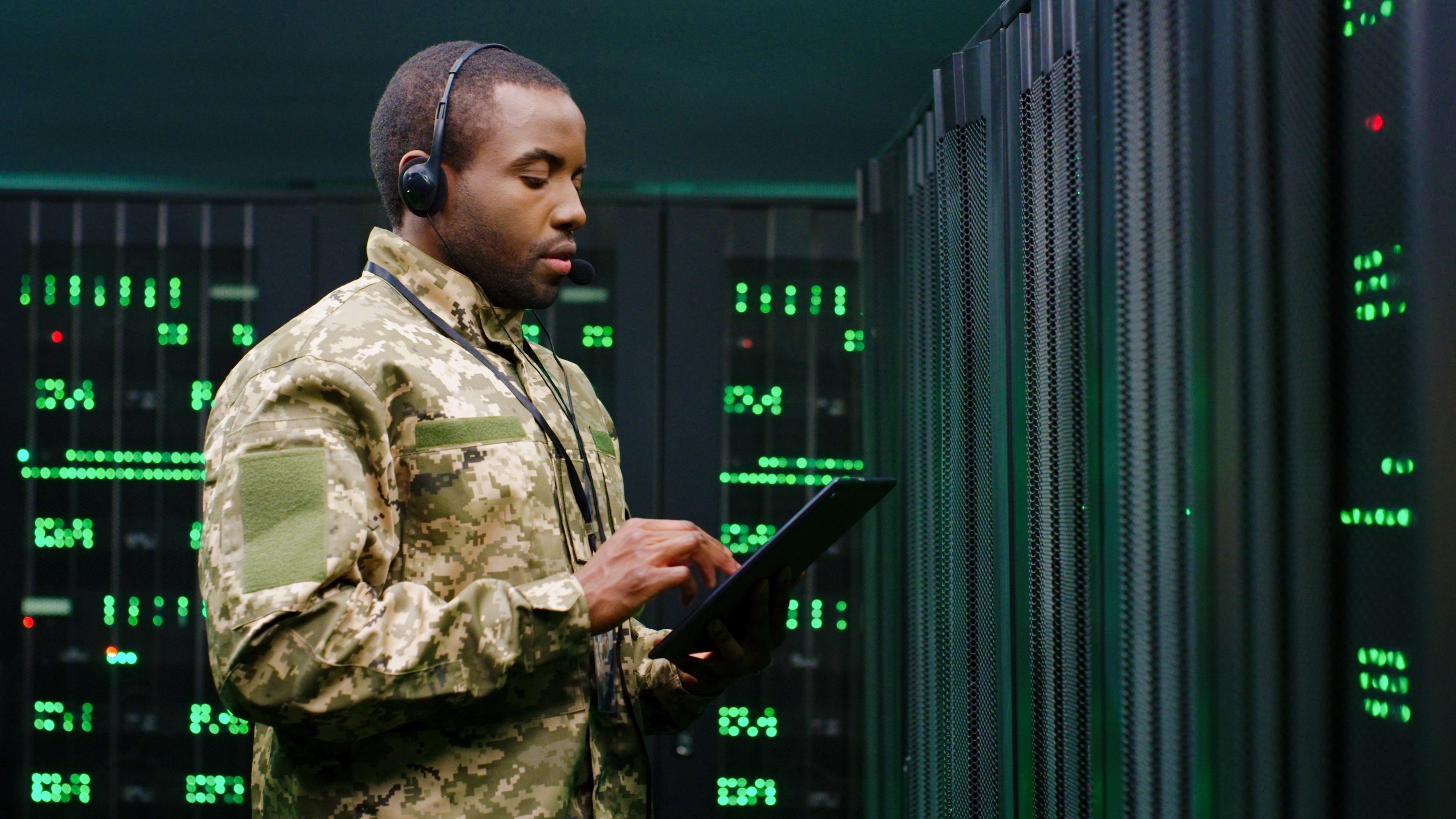
The international security landscape has undergone a profound transformation, with implications for contemporary military conflict and the core role of cybersecurity systems in defence. In this extract from Nexova’s OpenSpace magazine, Roberto Mazzolin, Retired Brigadier General from the Canadian Armed Forces, explains how and why nations must adapt their strategic, operational and technological approaches to maintain security and sovereignty.
You can read the full article and other cybersecurity and space articles in the latest issue of OpenSpace magazine.
Historically, wars were predominantly kinetic, with armed forces battling over land, sea and air domains to secure geographic advantages. Although ideological conflicts, such as communism versus free liberal societies, shaped alignments and motivations, the central considerations often boiled down to controlling territory or protecting economic lifelines. Fast forward to today and these drivers have become more complicated, with multiple dimensions and challenges.
Economic influence and access to natural resources are now as critical to international strategic competition as military superiority. For decades, a rules-based international economic order resulted in a relatively stable global system that promoted free trade and cooperation. Now, we’re starting to see a move towards a multipolar international environment – one with many important global powers, not just a few superpowers – which is intensifying regional tensions.
In this new environment, outright kinetic conflict between major powers is less desirable, because it can backfire significantly due to how intertwined the global economy is. For instance, crippling a rival nation’s infrastructure can inadvertently damage the attacker’s own economy through disrupted supply chains, energy markets or technological interdependencies. This forces countries to seek alternative means to project power, assert influence and achieve strategic objectives without triggering full-scale war. Wars are no longer solely kinetic – they are hybrid.
Protecting critical Infrastructures
One vital element that epitomises the complexity of contemporary security is the dependence of modern societies on interconnected critical infrastructures. Finance, agriculture, healthcare, telecommunications, energy and transportation all rely heavily on digital networks and space-based systems for effective operation. These systems form the backbone of a functioning society and, by extension, underpin the authority of national governments.
If critical infrastructures fail or are compromised, public confidence in government erodes rapidly. Twenty-first century national security therefore increasingly revolves around the ability to protect such critical infrastructures – both physically and digitally.
In recent years, space and cyber have each been defined as operational domains from a military context, alongside the traditional domains of air, land and sea. NATO explicitly acknowledges cyberspace and outer space as such, declaring cyberspace and space to be operational domains in 2016 and 2019 respectively. Many nations now have dedicated commands responsible for operations in these areas.
For NATO, cyber defence is central to its overall deterrence and defence posture. Its aim is to both protect its own networks and help allied nations to enhance their own national resilience and use cyber as an operational domain. To this end, it has made continuing efforts to coherently engage industry and external partners.
Meanwhile, the European Union’s (EU’s) main framework is the EU Cyber Defence Policy, which was first adopted in 2014. In addition, the EU’s Cyber Diplomacy Toolbox is a joint EU diplomatic response to malicious cyber activities within the Common Foreign and Security Policy. The aim is to help prevent conflicts, mitigate cybersecurity threats and promote greater stability in international relations, including by influencing the behaviour of potential aggressors. Building on this, in June 2025, the EU adopted the EU blueprint for cyber crisis management, which gives guidance for the EU’s response to large-scale cybersecurity incidents or cyber crises.
Cyber and space as strategic domains
The internet and satellite-based systems provide fundamental tactical capabilities: telecommunications, positioning, navigation and timing (PNT), and Earth observation (EO). There is virtually no critical infrastructure untouched by these networks and technologies. Consequently, any state actor seeking to influence, coerce or degrade a rival nation’s capabilities is increasingly likely to focus on the cyber and space domains.
It is no surprise, then, that the past decade has witnessed a shift whereby both cyber and space have been elevated to the same strategic level as conventional domains. This evolution has been driven by multiple factors in modern conflict, including recognition of the electromagnetic spectrum as vital to command and control, situational awareness and the ability to deploy forces beyond national borders. Russia and China both view control of cyber and electronic warfare as central to their broader military and geopolitical objectives. Their tactics range from cyber espionage and sabotage to misinformation campaigns designed to sow discord and weaken adversaries internally.
Cyber and space domains serve as critical tools during times of both peace and conflict. They enable calibrated, remediable effects that can be deployed strategically prior to or alongside kinetic military operations. When you have that continuum from peace through crisis to high-intensity conflict, cyber warfare becomes an attractive, cost-effective method of achieving national objectives without crossing thresholds that typically demand full military mobilisation. Cyber, along with space, is now likely to be the first domain attacked in any conflict.
Cyber commands
In recent decades, armed forces have increasingly established dedicated cyber units, often referred to as ‘cyber commands’. This trend reflects the expansion of operational domains into cyberspace and the growing need to strengthen the cyber defence of military networks and systems to ensure their continuous operational availability.
These cyber commands are tasked with conceiving, planning and conducting military operations in cyberspace. To achieve these objectives, they are equipped with substantial capabilities for monitoring IT/OT networks and incident response, including security operations centres (SOCs), enabling them to react immediately in case of an intrusion or attack.
Cyber commands place a strong emphasis on training and preparedness using cyber-ranges. These dedicated simulation environments, known as digital twins, allow military cyber operators to practice defending complex, realistic network architectures against sophisticated adversary scenarios. By replicating both friendly and hostile cyber infrastructures, cyber-ranges provide a safe yet highly realistic environment for testing defensive tactics, refining offensive cyber capabilities and conducting large-scale joint exercises.
Some cyber commands will already have a complete set of cybersecurity facilities, including both SOCs and cyber-ranges. Others may utilise managed services, such as those provided by Nexova’s Cybersecurity Centre of Excellence, to address one or more requirements, as either their primary solution or an additional layer of cybersecurity.
Strategic integration of cyber
Cyber operations do not function in isolation. Instead, they must be integrated seamlessly with other warfare activities. Offensive cyber operations can disrupt enemy command and control, degrade situational awareness or kill logistics flows, amplifying the effectiveness of kinetic strikes or diplomacy. Meanwhile, defensive cyber operations ensure the continuity and resilience of one’s own infrastructure and communications. The interplay between offensive and defensive cyber activities often forms a silent but decisive battlefield where establishment or denial of cyber presence can alter the entire conflict’s trajectory.
Given the sophistication of adversary cyber capabilities, cyber warfare requires meticulous planning. National actors must consider operational risks, geopolitical consequences and financial costs before launching cyber operations.
Neutralising a target with a few lines of malicious code may be far cheaper than a multi-million-dollar missile strike, but the risks of escalation or counterattack remain formidable.
Cyberattacks and resilience
When looking at the nature of potential armed conflict, it’s not a question of ‘if’ a cyberattack will happen, but ‘when’.
Building resilience demands that nations marshal their full military, industrial and civilian capabilities. Companies play an indispensable role, especially those operating critical infrastructure nodes. This dual-use nature of infrastructure demands close cooperation between governments and the private sector. Collectively, public agencies, industry leaders and specialist firms must cultivate a cybersecurity culture that prioritises resilience as a shared responsibility.
Navigating the complex security landscape
The ever-evolving international security environment is compelling nations to rethink traditional assumptions about war, peace and power. Economic imperatives and technological interdependencies are creating new vulnerabilities and opportunities. Within this context, cybersecurity and space-based systems have become indispensable arenas of strategic competition and military conflict.
Success in this nuanced environment depends on comprehensive strategies that fuse technological innovation, resilient infrastructures, joint military capabilities and cooperative partnerships. Nations must invest not only in capabilities, but also in leadership awareness and organisational culture to mitigate the complex risks of today’s cybersecurity landscape. Cybersecurity is now far more than a technical domain; it is a cornerstone of national and international security, sovereignty and survival.
Download the PDF to read the full article
Find out more
This is an extract from the latest issue of OpenSpace magazine. Subscribe to read the full version and more, including articles on digital twins and the Cyber Resilience Act.